If you’ve ever been told you have high cholesterol and heart disease is something you need to worry about, you probably know how quickly the conversation can move from a lab result to medication.
For many people, there’s little discussion in between. The LDL is elevated, a statin is recommended, and the goal becomes getting that number lower by the next blood draw.
But I believe a very important question is missing from that conversation: Why is the cholesterol pattern changing in the first place?
That is where I start.
I am not saying LDL does not matter. It does. What I am saying is that LDL is information, and information without context can lead us to treat a number without understanding the person producing that number.
Consider two people who both have an LDL cholesterol of 140. One is physically active, has good glucose regulation, normal triglycerides and blood pressure, no evidence of fatty liver, and no detectable coronary calcium. The other has the same LDL along with rising blood sugar, high triglycerides, abdominal weight gain, fatty liver, poor sleep, elevated blood pressure, and a strong family history of heart disease.
Those two people do not have the same health picture simply because their LDL happens to be the same.
That is the difference between looking at cholesterol through a conventional, numbers-based approach and through a functional-health lens. I want to understand what is happening throughout the body, what may be contributing to the pattern, and what we can change before reducing the entire conversation to “good cholesterol,” “bad cholesterol,” and medication.
In Episode 77 of The Heal Deal Podcast with Dr. Leona, I talked about why I believe our cholesterol conversation has become far too simplistic. Since that episode aired, the ACC and AHA released new dyslipidemia guidelines in 2026. Interestingly, even those guidelines now recognize that LDL alone does not tell us everything we need to know about cardiovascular risk.
Cholesterol Is Not the Enemy
One of the biggest problems with the way we have talked about cholesterol for decades is that we have taught people to fear the molecule itself.
But your body needs cholesterol.
Cholesterol is part of the structure of every cell membrane in your body. It is involved in the production of steroid hormones, bile acids, and vitamin D, and it is especially important to the nervous system and brain.
None of that means that having more cholesterol circulating in your bloodstream is automatically better or that high levels should simply be ignored. It means cholesterol is not some foreign substance your body is desperately trying to get rid of. It has a job.
That is why I think the terms “good cholesterol” and “bad cholesterol” have caused so much confusion. HDL and LDL are not actually two different types of cholesterol. They are lipoproteins, particles your body uses to transport cholesterol and other fats through the bloodstream.
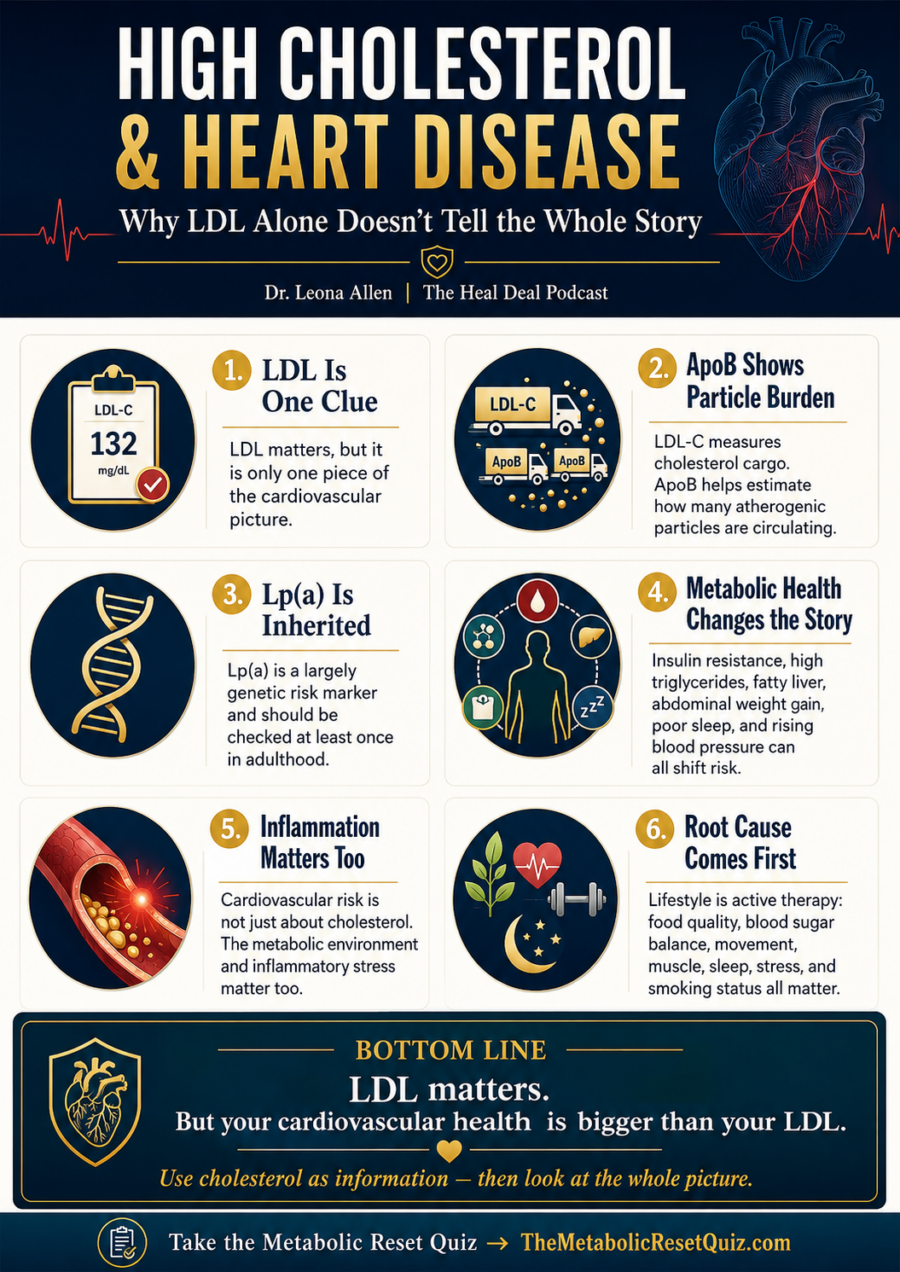
I often explain it using delivery trucks. The cholesterol is part of the cargo. The lipoproteins are the trucks transporting that cargo.
LDL particles carry cholesterol and other lipids through circulation, while HDL helps move cholesterol back to the liver for processing and recycling. Both are part of normal human physiology.
The cardiovascular concern is not simply that LDL exists. The concern is what happens when a high burden of atherogenic particles circulates over time, enters the arterial wall, and contributes to atherosclerosis.
That distinction may sound subtle, but it changes the entire conversation. Instead of simply asking whether an LDL value is high or low, we begin asking what that number actually represents.
What Your LDL Number May Be Missing
When you look at a standard cholesterol panel, LDL-C tells you how much cholesterol is being carried inside LDL particles. What it does not directly tell you is how many of those particles you actually have.
This is where my delivery-truck analogy becomes useful.
Imagine two highways carrying the same amount of cargo. On one highway, a relatively small number of trucks are carrying large loads. On the other, there are far more trucks, but each truck is carrying less.
If all you measured was the cargo, the two highways might look very similar. But traffic volume is very different.
Something similar can happen with LDL cholesterol. Two people can have similar LDL-C values while having very different numbers of atherogenic particles. This is particularly relevant in people with insulin resistance, diabetes, elevated triglycerides, or metabolic syndrome, where cholesterol content and particle number can become mismatched.
That is why ApoB has become so valuable.
Why ApoB Gives Us Another Piece of the Picture
Apolipoprotein B is found on the particles capable of contributing to atherosclerosis. Because each particle carries an ApoB molecule, the test gives us a much better idea of how many atherogenic particles are circulating, rather than simply how much cholesterol cargo they contain.
This does not mean everyone needs an advanced panel or that LDL-C has suddenly become useless. It means that when the rest of someone’s metabolic picture doesn’t match their LDL result, ApoB can help us see what the standard panel may be missing.
The 2026 guidelines have moved further in this direction. They still focus heavily on lowering LDL, but they now place greater emphasis on ApoB in selected patients, coronary artery calcium when treatment decisions are uncertain, and Lp(a)—another important particle that most people have never had checked.
Lp(a) is especially interesting because it is largely genetic. Someone can exercise regularly, eat well, maintain a healthy weight, and still have a significantly elevated Lp(a). The new guideline recommends that adults have it measured at least once.
From my perspective, that is useful information. But the goal of finding another abnormal number should not be to create another thing to fear. If someone learns that they carry an inherited cardiovascular risk they cannot easily change, that makes the things they can change even more important.
The Metabolic Pattern Behind High Cholesterol and Heart Disease
This is where I believe the functional-health perspective adds something important to the cholesterol conversation.
High cholesterol does not always appear by itself. Very often, it is part of a much larger metabolic pattern.
As insulin resistance develops, the liver begins handling energy differently. Triglycerides may rise, more triglyceride-rich particles are produced, HDL may fall, and the number and characteristics of LDL particles can change. Meanwhile, that same person may begin accumulating more abdominal fat, developing fatty liver, experiencing higher blood pressure, and requiring more insulin to keep blood glucose under control.
When I see those things happening together, I do not see a collection of unrelated diagnoses. I see a system under metabolic stress. That matters because simply lowering LDL does not necessarily correct that system.
Imagine someone whose LDL is 135, but whose triglycerides are 220. Their A1C has been creeping upward, they have gained weight around the abdomen, their ultrasound shows fatty liver, their blood pressure is climbing, and they are sleeping five hours a night.
If the entire treatment conversation becomes “we need to get your LDL down,” we have missed an enormous part of what their body is telling us.
Yes, lowering an important cardiovascular risk factor may have value. But it doesn’t reverse insulin resistance, restore sleep, rebuild lost muscle, correct fatty liver, or automatically bring blood pressure and glucose regulation back into balance. That is why I keep coming back to the root cause.
Why I Also Pay Attention to Insulin
For many people in my practice, I also want to know what their insulin is doing. Fasting insulin is not currently a standard ACC/AHA cardiovascular treatment target, and I do not use it as a replacement for established cardiovascular markers. I use it because it can tell me what is happening metabolically before fasting glucose becomes obviously abnormal.
The body can keep glucose looking “normal” for years by producing more and more insulin. During that time, the person may already be developing high triglycerides, abdominal weight gain, fatty liver, cravings, and other signs that the metabolism is changing.
A normal glucose result does not always mean the metabolism is normal. That is the context I am looking for.
Cholesterol and Inflammation Are Connected
In my original podcast episode, I talked strongly about inflammation because I believe it is a major part of the cardiovascular story. I still do.
Today, I’ll explain more precisely that this isn’t an argument about whether cholesterol or inflammation causes heart disease. The two processes interact.
ApoB-containing particles can enter and become retained in the arterial wall. Once there, those particles can change in ways that activate the immune system and trigger an inflammatory response. Over time, this contributes to plaque formation and, in some cases, plaque instability.
So the particles matter. But the environment in which those particles are circulating matters too.
That is one reason lowering LDL does not make every other cardiovascular risk disappear. Someone may achieve an excellent LDL number while still struggling with insulin resistance, uncontrolled blood pressure, diabetes, smoking, high Lp(a), kidney disease, poor sleep, or persistent inflammation.
A “good” cholesterol report does not automatically mean the person is metabolically healthy.
High-sensitivity C-reactive protein, or hs-CRP, is one marker that can sometimes give us additional information about systemic inflammation. It is not specific to cardiovascular disease. Many things can raise CRP, but in the appropriate context it can help us see another part of the picture.
What interests me most is not simply whether CRP is elevated. I want to know why.
Excess visceral fat and poor glucose regulation can create inflammatory signaling. So can smoking, chronic inflammatory disease, untreated infection, periodontal disease, disrupted sleep, and many other conditions. The answer will not be identical for every person, which is exactly why treating the patient rather than chasing one laboratory number matters.
When Knowing Whether Plaque Is Already There Can Help
Sometimes laboratory numbers leave a person stuck in the middle.
Their LDL is elevated, but they have never had a cardiovascular event. Perhaps their calculated risk is not particularly high, their other markers look reasonably good, and they are trying to decide whether medication makes sense.
In the right person, a coronary artery calcium scan can add useful information.
A CAC scan is a specialized CT scan that looks for calcified plaque in the coronary arteries. It does not show every type of plaque, and a score of zero does not mean there is absolutely no cardiovascular risk. But it answers a different question from a cholesterol test.
Instead of estimating risk based on a blood marker, we are looking for evidence that calcified atherosclerosis has already developed.
That can change the conversation.
If significant plaque is present, I take that seriously. If no calcified plaque is detected in an otherwise lower-risk person, that information may also help the patient and their healthcare provider think more carefully about how aggressive treatment needs to be.
Again, it is not about finding one perfect test. It is about putting the pieces together.
Where I Stand on Statins
This is probably where the cholesterol conversation becomes most divided.
I am not anti-medication. I am also not comfortable with medication becoming the automatic response to an isolated laboratory number. Those are two very different positions.
There are people with established cardiovascular disease, familial hypercholesterolemia, significant plaque, or other very high-risk situations where the medication conversation is completely different. Someone who has already had a heart attack is not the same as a lower-risk person whose LDL happened to come back moderately elevated during a routine physical.
Yet patients can sometimes receive nearly identical messages: your cholesterol is high, therefore you need a statin.
For people who are not already at high cardiovascular risk, I believe lifestyle and metabolic intervention deserve a meaningful role in the decision when it is clinically appropriate and safe to do so.
And by lifestyle, I do not mean telling someone to “eat better and exercise” on the way out of the room.
Lifestyle is treatment.
If insulin resistance is driving the metabolic pattern, then we work on insulin resistance. If someone is losing muscle as they age, rebuilding muscle changes glucose disposal and metabolic health. Poor sleep, especially undiagnosed sleep apnea, can affect blood pressure, insulin sensitivity, appetite, and inflammation. A diet dominated by refined carbohydrates and ultra-processed foods can show up in triglycerides, glucose regulation, fatty liver, and body composition.
These are not little side projects that matter only after the “real treatment” has happened. They are part of the treatment.
And even when someone ultimately decides that medication is appropriate, those issues still need to be addressed.
Understanding the Benefits and the Trade-Offs
Statins may reduce cardiovascular events in certain populations. What often gets lost in the conversation is that the amount of benefit depends heavily on how much risk a person had to begin with.
This is where relative and absolute risk matter.
A medication may be described as reducing an event by 30 or 40 percent, and that sounds enormous. But that percentage alone does not tell an individual patient how many people like them would actually avoid an event because they took the drug.
For someone who already has cardiovascular disease, there are more events available to prevent, so the absolute benefit may be substantial. For someone at very low baseline risk, the absolute benefit may be much smaller even if the relative percentage sounds impressive.
I believe patients deserve to know the difference before committing to long-term treatment.
They also deserve an honest conversation about side effects.
I hear complaints of muscle pain, weakness, fatigue, and changes in exercise tolerance from people taking statins. Randomized trials report a smaller drug-attributable increase in muscle symptoms than we hear about in everyday clinical practice, and that evidence should be acknowledged. But I also do not believe someone’s symptoms should be dismissed simply because a trial tells us what happened to the average participant.
If a person was active and strong before starting medication and now struggles with weakness or unusual muscle symptoms, I want that investigated. The medication may be contributing, or something else may be going on. Either way, the answer should not be automatic dismissal.
The diabetes question deserves the same attention. Statins can modestly increase the likelihood of developing diabetes, particularly in people who are already metabolically vulnerable. If someone already has prediabetes, insulin resistance, fatty liver, high triglycerides, or abdominal obesity, I consider that especially relevant.
It makes little sense to focus exclusively on lowering LDL while ignoring the metabolic terrain that is simultaneously moving the person toward diabetes.
That does not mean a person with very high cardiovascular risk should automatically reject a statin. It means we need to stop pretending that lowering one risk comes with no trade-offs or that we don’t need to address the rest of the physiology.
What About the Brain and CoQ10?
The concerns people raise about cholesterol and brain health also deserve more thoughtful discussion than they usually receive.
The brain is one of the most cholesterol-rich organs in the body, and cholesterol plays an essential role in cell membranes, synapses, and normal neurological function. The brain also produces much of its own cholesterol, which is one reason I would not make the overly simplistic claim that lowering blood LDL automatically “starves” the brain.
At the same time, some people do report brain fog, memory changes, or other cognitive symptoms after starting statins. Large randomized trials have not demonstrated a consistent increase in dementia from statin therapy, but I do not think that gives us permission to dismiss what an individual patient experiences.
Clinical trials tell us what happens on average. They do not tell us that everyone responds the same way. If a new symptom appears after introducing a medication, it deserves to be taken seriously and evaluated in context.
CoQ10 is similar. Statins affect the mevalonate pathway, which is involved in both cholesterol and CoQ10 production, and statin therapy can reduce circulating CoQ10. Whether supplementation consistently relieves statin-associated muscle symptoms remains unsettled because studies have produced mixed results.
For me, that simply reinforces the importance of individualized care rather than blanket statements in either direction.
The Goal Is Better Health, Not Just Better Cholesterol
This is ultimately where the functional-health approach differs. My goal is not simply to get a laboratory number into the reference range. My goal is to understand why the pattern developed, reduce cardiovascular risk, and improve the person’s overall health.
Sometimes that begins with food. Someone whose triglycerides, glucose, and insulin are climbing may need to take a serious look at refined carbohydrates, added sugars, and ultra-processed foods rather than simply trying to eat “low cholesterol.” Adequate protein, fiber-rich whole foods, and quality fats can help rebuild a healthier metabolic pattern.
Movement matters for reasons that go far beyond calorie burning. Building and maintaining muscle improves insulin sensitivity and glucose disposal, while regular cardiovascular activity supports blood pressure, vascular function, fitness, and overall cardiovascular health.
Sleep matters because a person who is chronically sleep-deprived or living with untreated sleep apnea may struggle with blood pressure, glucose regulation, appetite, and inflammation regardless of what their cholesterol number says.
And stress matters. Not because stress explains every disease, but because chronic stress changes sleep, food choices, blood pressure, glucose regulation, recovery, and the behaviors a person can sustain over time.
When you begin looking at health this way, cholesterol stops being an isolated problem. It becomes one piece of a larger story.
What I Want You to Take Away From This
If your LDL comes back high, I do not want you to panic. I also do not want you to ignore it. I want you to understand it.
The standard cholesterol panel does not tell the full story. ApoB may reveal a particle burden that LDL-C does not show clearly. Lp(a) may uncover inherited risk that has never been tested, while a coronary calcium scan can sometimes help determine whether risk factors have already translated into detectable disease.
But I would also look at what is happening throughout the rest of the body. When rising triglycerides, abdominal weight gain, fatty liver, worsening glucose regulation, increasing blood pressure, poor sleep, and declining muscle begin appearing together, those are not random problems living in separate compartments.
They may be different expressions of the same metabolic dysfunction. That is the part I do not want us to miss. I do not want you treating a cholesterol number while ignoring the person who produced that number.
LDL matters. But your cardiovascular health is bigger than your LDL.
And before you make a long-term decision based on one laboratory result, you deserve to understand the complete picture.
Frequently Asked Questions
Is high LDL automatically a reason to take a statin?
Not for every person. The meaning of an elevated LDL depends on the person’s overall cardiovascular risk and health history. Someone with established cardiovascular disease or significant plaque has a very different risk profile from someone with moderately elevated LDL but no known disease and otherwise low risk. For lower-risk people, I believe lifestyle and metabolic health deserve serious attention before medication becomes an automatic response, when it is medically appropriate to do so.
Why would I check ApoB if I already know my LDL?
LDL-C tells us how much cholesterol is being carried in LDL particles, while ApoB gives us a better estimate of the number of atherogenic particles. Those two measurements can tell different stories, especially when insulin resistance, elevated triglycerides, diabetes, or metabolic syndrome is present.
Can insulin resistance affect my cholesterol?
Yes. Insulin resistance can change how the liver handles triglycerides and lipoproteins, leading to elevated triglycerides, lower HDL, and more cholesterol-depleted LDL particles. That is one reason I don’t evaluate cholesterol separately from the rest of a person’s metabolic health.
If my LDL drops on a statin, does that mean the underlying problem is fixed?
Not necessarily. Lowering LDL can address one important aspect of cardiovascular risk, but it does not automatically resolve insulin resistance, fatty liver, high blood pressure, poor sleep, smoking, metabolic dysfunction, or other contributors to cardiovascular disease. Those issues still need their own attention.
Can statins cause muscle weakness or cognitive symptoms?
Statins can cause muscle symptoms in some people, although randomized trials suggest the medication itself accounts for fewer symptoms than observational reports imply. Some people also report cognitive changes. Large randomized trials have not shown a consistent increase in dementia, but clinicians should still evaluate individual symptoms rather than dismiss them simply because they are uncommon in a study population.
Want to Know What Your Numbers May Be Telling You?
Your cholesterol is only one piece of the picture. If you’re seeing changes in your cholesterol, blood sugar, blood pressure, weight, energy, or other health markers, the next step is to understand how those pieces may be connected.
Take The Metabolic Reset Quiz to better understand what may be happening beneath the numbers and where to focus next.
Take the quiz at: TheMetabolicResetQuiz.com
This article is for educational purposes only and is not a substitute for individualized medical care. Do not start, stop, or change prescribed medication without working with a qualified healthcare professional.
References
- American Heart Association and American College of Cardiology. 2026 Guideline on the Management of Dyslipidemia: Top Things to Know.
- Blumenthal RS, et al. 2026 ACC/AHA Multisociety Guideline on the Management of Dyslipidemia. Circulation / Journal of the American College of Cardiology. 2026.
- Ference BA, et al. Causal Effect of Lipids and Lipoproteins on Atherosclerosis. European Heart Journal. 2018.
- Sniderman AD, et al. Apolipoprotein B Versus Non-HDL Cholesterol and LDL Cholesterol as Markers of Cardiovascular Risk. Circulation: Cardiovascular Quality and Outcomes. 2011.
- Ridker PM, et al. Rosuvastatin to Prevent Vascular Events in Men and Women with Elevated C-Reactive Protein. The New England Journal of Medicine. 2008.
- Ridker PM, et al. Antiinflammatory Therapy with Canakinumab for Atherosclerotic Disease. The New England Journal of Medicine. 2017.
- Cholesterol Treatment Trialists’ Collaboration. Effect of Statin Therapy on Muscle Symptoms: An Individual Participant Data Meta-Analysis. The Lancet. 2022.
- Cholesterol Treatment Trialists’ Collaboration. Effects of Statin Therapy on New-Onset Diabetes and Worsening Glycaemia. The Lancet Diabetes & Endocrinology. 2024.
- Ott BR, et al. Do Statins Impair Cognition? A Systematic Review and Meta-Analysis of Randomized Controlled Trials. 2015.
- Qu H, et al. Effects of Coenzyme Q10 on Statin-Induced Myopathy: An Updated Meta-Analysis of Randomized Controlled Trials. Journal of the American Heart Association. 2018.