
You are standing in the meat section of your grocery store. You reach for a package of chicken, glance at the label, and put it in your cart. It said chicken. That was the decision.
If that is how you buy meat, you are not alone. And if you have ever assumed that a package labeled chicken came from a chicken raised on a farm, you are asking the right question about a food system that has changed faster than most people realize.
Lab-grown meat is no longer a science experiment. By 2026, cultivated chicken, salmon, and pork fat have all entered limited U.S. sales. Five companies have finished FDA pre-market consultations. Restaurants in San Francisco, Washington D.C., and Portland have served these products. At least one grocery store in California has too, in a specific product debut, not widespread availability. Eight states have banned or paused sales. Others have passed new labeling laws.
This article breaks down what has actually changed, what the industry calls this food and why the name matters, how it is made, where it is legal and where it is not, and what to look for the next time you stand in the meat aisle.
In Episode 98 of The Heal Deal Podcast with Dr. Leona, I walked through what cultivated meat actually is, how it has moved from a research demonstration to a product on grocery shelves, and what to check before you put one of these products in your cart.
What Has Actually Changed In The Last Three Years
Cultivated meat is not new science. What is new is that it is now being sold to real customers.
- 2013: Researchers presented the first widely publicized cultivated beef burger. It cost hundreds of thousands of dollars to make.
- 2015: Memphis Meats, now known as Upside Foods, was founded. That marked the shift from university research to companies producing this food commercially.
- 2020: Singapore became the first country to allow the sale of a cultivated meat product.
- 2022: The FDA completed its first pre-market consultation for cultivated chicken.
- 2023: Cultivated chicken entered limited restaurant service in the United States.
- 2025: A cultivated product reached limited grocery stores.
- 2026: As of February, the FDA’s public inventory showed completed pre-market consultations for products from five companies.
The most notable recent moment: in November of last year, for the first time, a product made with cultivated pork fat was sold in a U.S. grocery store at Berkeley Bowl West in California. Restaurants in San Francisco and Washington D.C. have served cultivated chicken. A restaurant in Portland has served cultivated salmon.
The pace has picked up. What was a research demonstration ten years ago is now a regulated commercial food being reviewed one product at a time.
What They Call It And Why The Name Matters
This product goes by many names. Which one you hear depends on who is talking.
- Lab-grown meat: the general name most consumers know.
- Cultivated meat: the term the industry prefers. Used by companies like Upside Foods, Good Meat, Mission Barns, Wildtype, and Believer Meats. Current availability differs by company and product.
- Cell-cultured or cell-cultivated: the language federal regulators use, particularly the USDA.
- Cell-based, cultured meat, clean meat, synthetic meat: same category, different framing.
Research on consumer perception shows that a product’s name changes how people feel about it. When people hear lab-grown, they picture something artificial. When people hear cultivated, they picture something grown, tended, and cared for. Same basic category, different picture. That is not an accident.
On September 12, 2026, a new Arizona state law took effect called the Andy Groseta Act, named after a cattle rancher. It requires any food made from cultivated animal cells to be labeled cell-cultivated or cell-cultured on the package. It does not ban the product. It says the consumer has the right to know what it is. The law passed with strong bipartisan support: 52 to 3 in the House, 24 to 5 in the Senate.
One important distinction: Beyond Meat and Impossible Foods are not cultivated meat. They are plant-based imitation products, made from isolated proteins, oils, starches, binders, flavors, and colors. They are a different category. And plant-based does not automatically mean whole food. A bean is a whole plant food. An industrial formulation assembled from isolated plant components is something completely different. We should not pretend they are the same.
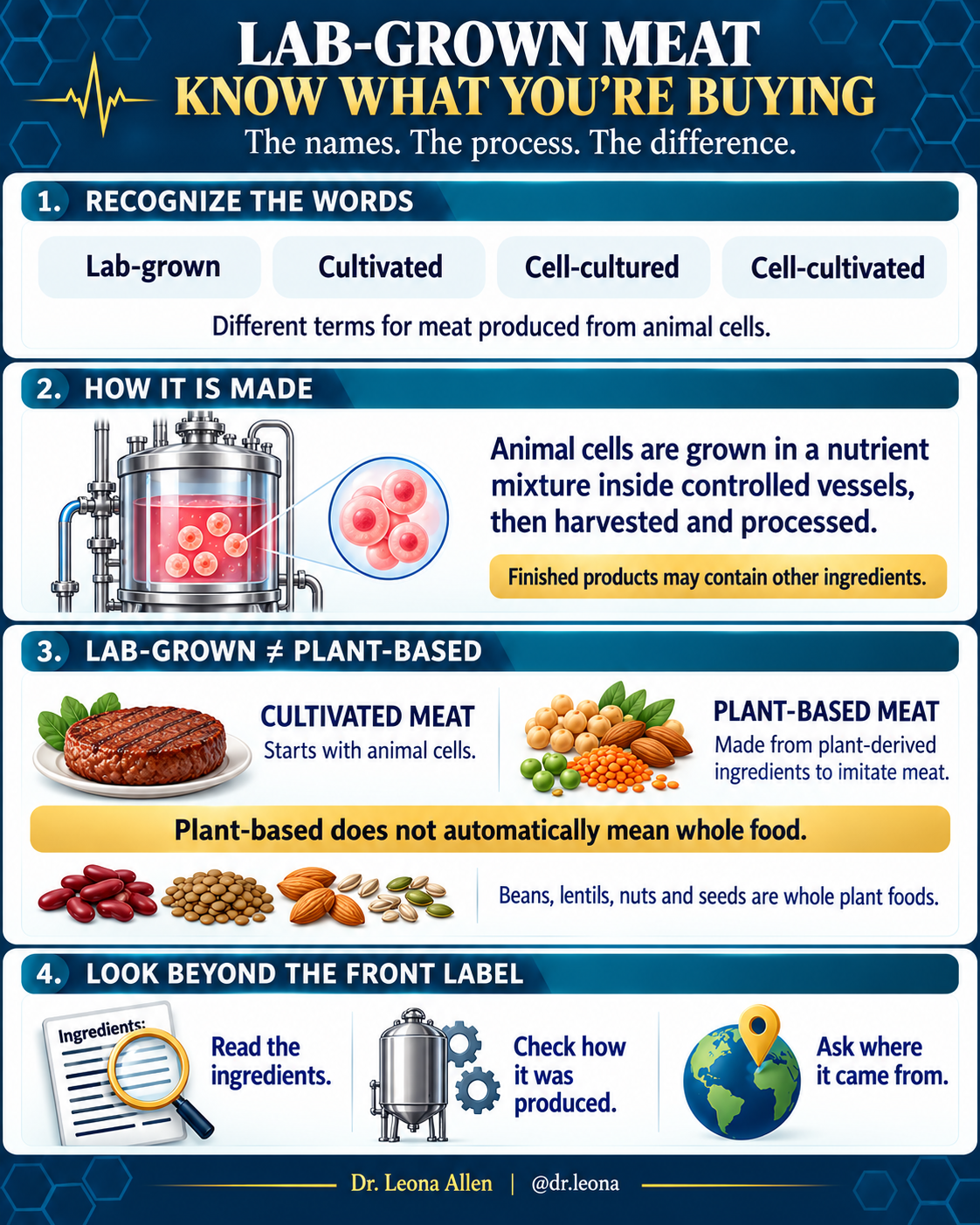
How Lab-Grown Meat Is Actually Made
Here is the process in plain language.
- A company takes a small sample of living cells from an animal, usually chicken, cow, or fish.
- The cells are selected and used to build a cell bank for future production.
- The cells are grown in progressively larger vessels until they reach large silver tanks called bioreactors. If you have ever seen a brewery, they look similar.
- Inside the tanks, the cells are fed a liquid mixture called growth medium. It supplies amino acids, sugars, salts, vitamins, minerals, and signaling substances called growth factors.
- Once enough cells have multiplied, manufacturers use different nutrients or a scaffold to guide the cells to develop into muscle, fat, or connective tissue.
- The cells are harvested and may be shaped, seasoned, or combined with plant proteins, oils, binders, or flavorings to make the finished product.
Two things worth understanding:
A product made with cultivated cells is not necessarily made entirely from those cultivated cells. Many finished products combine cultivated animal cells with plant-based ingredients. The label may say cell-cultured without listing everything used to grow the cells in the first place.
One growth medium ingredient historically used is fetal bovine serum, or FBS, derived from blood collected from bovine fetuses during the slaughter of pregnant cows. Its use has been contested, and companies are working to develop serum-free alternatives. Not every product uses FBS, and inputs differ by company.
The FDA reviews the cell lines, cell banks, production process, and manufacturing controls during pre-market consultation. But for meat and poultry, the pathway does not end there. Oversight shifts to the USDA at the point of harvest, and the USDA then oversees inspection, further processing, and labeling. Most seafood remains under FDA oversight. So a completed FDA consultation is not the same as full permission to sell a meat or poultry product. It is one step in a product-by-product process involving different agencies and additional requirements.
Even beyond that, a food safety review is not the same as a long-term health outcome study. We do not have decades of widespread human consumption data. Regulatory clearance for sale is not the same as proof that this product is the best choice for your long-term health.
Where This Is Legal, Where It Is Banned, And Where Labels Are Required
The states are not lining up behind the federal government. This story is being written state by state.
Eight states have enacted bans or moratoriums affecting cultivated meat: Florida, Alabama, Mississippi, Montana, Nebraska, Indiana, Texas, and South Dakota. Details vary. Some prohibit both manufacturing and sales. Others have temporary restrictions. Indiana and Texas expire in 2027. South Dakota’s five-year prohibition runs from July 2026 through June 2031.
Arizona requires labeling. As of September 12, 2026, any cultivated product sold in Arizona must carry cell-cultivated or cell-cultured on the package.
Georgia, where I am based, requires cell-cultured products represented as meat to be labeled on the front as lab-grown, lab-created, or grown in a lab. Different words, same intent.
Check your state’s current law. If you live in one of the eight states with restrictions, the rules affect what can be sold where you live. If you are anywhere else, label requirements may vary. Federal oversight does not guarantee that every package in every state will use the one phrase you personally recognize.
How To Read A Label And Shop With Confidence
Here is what to look for the next time you are in the meat section.
Watch for these words on the package, on the front, back, product name, or ingredient list: cultivated, cell-cultured, cell-cultivated, cell-based, cultured meat. Also learn the brand names of companies developing these products: Upside Foods, Good Meat, Mission Barns, Wildtype, and Believer Meats.
Ask yourself first: does it still look like food? Is it a recognizable cut of meat or fish with a short ingredient list, or is it a formulation designed to imitate something it is not?
For chicken, look for pasture-raised with credible third-party certification or a producer who explains their practices. The words natural, cage-free, and free-range do not all mean the same thing.
For beef, if grass-based feeding matters to you, look for 100% grass-fed and grass-finished with credible verification. Do not rely on a pastoral photo on the package. Read what the company is actually claiming.
For fish, choose wild-caught when available. Check the species and country of origin. Farm-raised is not one single system, and practices vary.
For eggs, pasture-raised eggs from a transparent producer, or backyard chickens if that is an option for you.
I hear some of you thinking this sounds expensive. Expensive compared to what? Cheap grocery store food becomes very expensive when you factor in poor health, lost energy, prescriptions, and time away from work. Do the best you can with your budget. Plain frozen meat or fish, canned wild salmon or tuna, eggs, beans or lentils, and seasonal produce are all good options. Buy the best quality you can reasonably afford, use as much of what you buy as possible, and cut back on ultra-processed foods.
The Bottom Line
Cultivated meat is no longer a distant experiment. It has entered limited U.S. sales, is legal in some states, banned in others, and labeled differently depending on where you live. Government clearance is not the same as proof of long-term safety. A legal product is not automatically a healthy product. And just because something can be manufactured does not mean it belongs on your plate.
You do not have to wait until these products are everywhere to start paying attention. Read the package. Read the ingredient list. Learn where your food comes from. Support local farmers when you can. Choose food that still looks like food.
Are you battling fatigue, brain fog, and weight that will not budge no matter what you try?
For many adults, the answer is not more willpower. It is looking at what your metabolism is doing.
I released a free breakthrough training that walks through the metabolic patterns behind those symptoms and a three-phase approach to addressing them. If you are ready to stop spinning your wheels and start looking at what may actually be going on, go to BeginHealingToday.com.
This article is for educational purposes only and is not a substitute for individualized medical care. Do not start, stop, or change prescribed medication without working with a qualified healthcare professional.